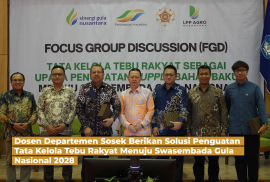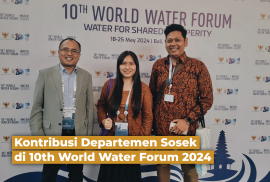
Lecturers from the Department of Agricultural Socioeconomics, Faculty of Agriculture, Gadjah Mada University (UGM), also contributed to the prestigious international event, the 10th World Water Forum (WWF), in Bali on 18-25 May 2024. This global meeting forum aims to discuss critical issues related to water, such as water resource management, access to clean water, sanitation, etc. With the theme “Water for Shared Prosperity,” this edition of WWF brings together global participation, knowledge exchange, innovative technology exhibitions, and a shared commitment to sustainable water solutions.
NEWS
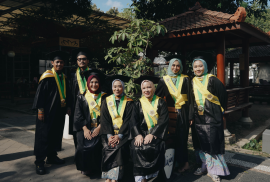
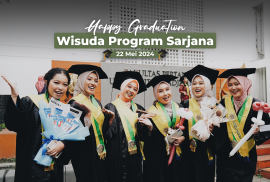
On May 22, 2024, Gadjah Mada University held the Period III Undergraduate Program Graduation for the 2023-2024 Academic Year with great fanfare. This event began with a university-level graduation procession, which was held simultaneously at the Grha Sabha Pramana Building, Gadjah Mada University. Next, the procession to send off faculty-level graduates was held at the Hardjono Danoesastro Auditorium, Faculty of Agriculture, UGM.
During this period, the Faculty of Agriculture graduated 96 male and female graduates from 9 undergraduate programs. The Department of Agricultural Socioeconomics (Sosek) also contributed by graduating 19 graduates from the Agricultural Extension and Communication Study Program and 17 from the Agricultural Economics and Agribusiness Study Program.
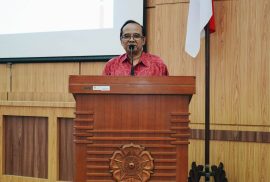
On Friday, May 17, 2024, the Department of Agricultural Socioeconomics, Faculty of Agriculture, Gadjah Mada University held a Judicial Ceremony for the Release of Graduates and Graduates in Room 203, MMA, Sosek Building A10. The event began with an opening, then continued with remarks from the UGM Department of Agricultural Socioeconomics Chair, Mr. Dr. Tall Handoyo Mulyo, M.Ec. In his speech, Mr. Jangkung advised the graduates always to uphold the good name of the alma mater, Gadjah Mada University, and to be individuals who are beneficial to the surrounding environment, according to the UGM motto, “Locally Rooted, Globally Respected.” He emphasized the importance of graduates remaining rooted in solid local values while striving to achieve global recognition through honest and positive societal contributions.
On Saturday, May 4, 2024, the Student Family of the Department of Agricultural Socioeconomics (KMSEP) at Gadjah Mada University, in collaboration with the Palm Oil Agribusiness Strategic Policy Institute (PAPSI) and the Palm Oil Plantation Fund Management Agency (BPDPKS), hosted a book review seminar titled “Myths vs Facts: Indonesian Palm Oil Industry in Global Social, Economic and Environmental Issues, Fourth Edition.” This event, graced by 221 participants, including esteemed figures from the industrial and academic sectors, aimed to foster a deeper understanding of the palm oil industry. Notable attendees included Dr. Ir. Tungkot Sipayung (Executive Director of PAPSI), Eddy Abdurrachman (Main Director of BPDPKS), and leading lecturers from Gadjah Mada University such as Dr. Dyah Woro Untari, Prof. Dr. Jamhari, Dr. Siti Mutiah Setiawati, and Prof. Dr. Ir. Sri Raharjo.
Recently, several young lecturers from the Department of Agricultural Socioeconomics, Faculty of Agriculture, Gadjah Mada University, released three inspiring books. This achievement not only reflects the dedication and competence of young lecturers in the Department of Agricultural Socioeconomics but is also a significant marker in the current development of Agricultural Economics and Agribusiness. With passion and in-depth knowledge, our lecturers have produced work that has the potential to become a major pillar in academic literature in their field.
On Saturday, April 27, 2024, an atmosphere of togetherness and warmth colored the Hardjono Danoesastro Auditorium, Faculty of Agriculture, Gadjah Mada University (UGM). The Syawalan of the Department of Agricultural Socioeconomics activities was finally held again after being stopped due to the COVID-19 pandemic. Attended by the entire extended family of the Department of Agricultural Socioeconomics, including students, lecturers, teaching staff, and other important figures, this activity was not just a routine gathering but also a special moment to reunite in warmth and togetherness.
On April 24, 2024, the Faculty of Agriculture, Gadjah Mada University, celebrated the Period III Postgraduate Program Graduation ceremony at the Hardjono Danoesastro Auditorium, Faculty of Agriculture UGM. This event marked the successful completion of academic journeys for 44 male and female graduates from 9 postgraduate programs, a collective achievement that we all can be proud of.
The Department of Agricultural Socioeconomics also contributed brilliantly by graduating 15 graduates from two of its superior programs. The Master’s Program in Agricultural Economics graduated one graduate, while the Master’s Program in Agribusiness Management graduated 14 graduates. This outstanding achievement indicates the Department of Agricultural Socioeconomics’ commitment to producing future leaders who are competent in their fields.
Mrs. Rosalia Natalia Seleky, Ph.D., brings a policy and innovation perspective from the country of Sakura. She enthusiastically shares her experience and knowledge in developing the motivation and skills of agricultural human resources through a targeted and effective extension approach. Meanwhile, Mr. Opik Mahendra, S.P., M.Sc., presented a deeply rooted local perspective. He raised awareness of the importance of extension in building farmers’ abilities and encouraged their enthusiasm in facing the challenges of the ever-evolving times.
This event is not just an intellectual meeting but also an important milestone in strengthening the connection between theory and practice in agriculture. Students are not only given knowledge but also inspiration to contribute significantly to alleviating existing agricultural problems. Not only is it academically relevant, but this activity also significantly impacts achieving the Sustainable Development Goals (SDGs). We are moving towards a more inclusive, sustainable, and competitive vision by empowering agricultural human resources through an extension approach.

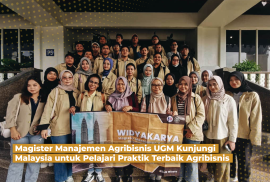
Widyakarya began with a visit to the Big Bee Garden, an educational tourist destination that offers in-depth insight into bee cultivation and pure honey production. Here, students gain new knowledge about the vital role of bees in the ecosystem and purchase high-quality honey products without added sugar. This experience provides a deeper understanding of the potential of the bee industry and its products in the context of agribusiness management.

Next, students visited YARA International, a leading company that produces and distributes high-tech fertilizers. Here, they had the chance to visit three exciting locations: distributor partners, farm partners, and bagging factories. Through this visit, students saw firsthand the manufacturing process and applying YARA fertilizer in the field and understood marketing and distribution strategies for modern agricultural products.

The next visit took students to the Bank for Agriculture and Agricultural Cooperatives (BAAC) Thailand, where they gained in-depth insight into the banking sector’s important role in supporting the agricultural sector’s growth. BAAC Thailand not only provides financial access to farmers but also provides education and assistance to ensure the sustainability of agricultural businesses. This provides a new perspective on how financial institutions can become strategic partners in developing agribusiness.

This scientific trip closed with a visit to Kasetsart University, a renowned higher education institution in Thailand. Here, students not only learn about the learning system and campus environment but are also introduced to various aspects of campus life. This opportunity is not only a learning opportunity but also expands networks and intercultural experiences for students.
Overall, this experience not only provides students with new knowledge but also adds in-depth insight into cultural diversity and the natural environment. Widyakarya 2024 will be an unforgettable journey, expanding students’ global horizons in applying agribusiness knowledge and supporting the sustainable development agenda.
At the event, lecturers from Tohoku University, Japan, Prof. Tsuyoshi Sumita, known as Sensei Tsuyoshi, Also present as moderator was Mrs. Rosalia Natalia Seleky, S.P., M.Agr., Ph.D. from the Laboratory of Agricultural Economics, Shimane University, Japan.
Prof. Tsuyoshi discusses Contract Farming in Japan in depth. He explains the concept of community farming, its differences from contract farming, and its history and sustainability in Japan. In the discussion, it is emphasized that Indonesia and Japan have similar challenges in the agricultural sector, especially related to the problem of the age of farmers who tend to be older and the lack of interest of the younger generation in being involved in agriculture.
Community farming in Japan originated from the need for labor during the cultivation process, giving rise to a labor exchange system between farming households. This system allows farmers to use machinery and coordinates the cultivation process and financial turnover. The production results are then marketed collectively through cooperatives.
Prof. Tsuyoshi not only provided an overview of the practice but also inspired the application of a similar concept in Indonesia, considering the country’s great potential in the agricultural sector. The success of community farming in Japan shows that coordination and efficiency can be achieved through this model, especially in terms of costs.
The importance of integrating this topic with the Sustainable Development Goals (SDGs) cannot be overlooked. Practices such as community farming and contract farming in Japan have great potential to support the achievement of several SDGs, especially those related to poverty alleviation, food security, and sustainable economic development.
Thus, this guest lecture provides new insights into the agricultural context and invites us to consider how these concepts can be adapted to achieve sustainable development goals.