
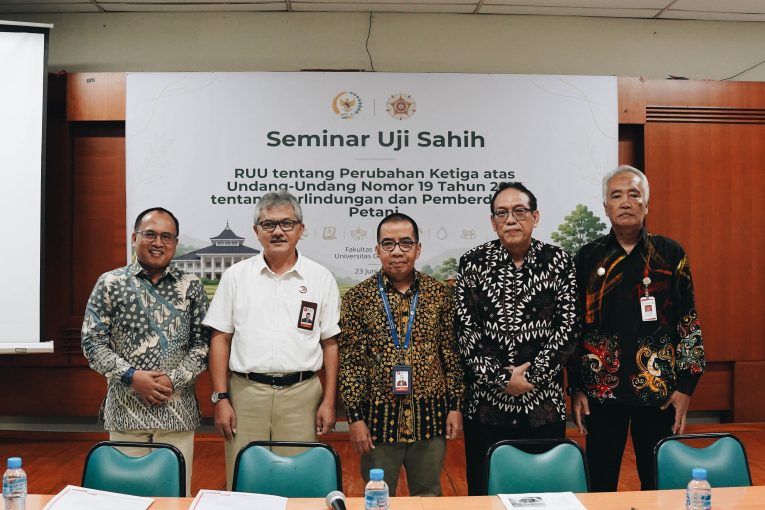
The Faculty of Agriculture, Universitas Gadjah Mada (UGM), hosted a Public Consultation Seminar on the Draft Law (Rancangan Undang-Undang/RUU) concerning the Third Amendment to Law No. 19 of 2013 on Farmers’ Protection and Empowerment, organized by Commission II of the Regional Representative Council (DPD RI) on Tuesday 23 June 2026. In this event, academics from the Department of Agricultural Socio-Economics (Sosek) UGM contributed through academic manuscript development and the provision of substantive inputs to the draft bill under preparation.
One of the key contributions was delivered by Prof. Subejo, S.P., M.Sc., Ph.D., who serves as a member of the Expert Team for the draft bill. He presented the main points of the Academic Manuscript and the proposed bill, which are directed toward achieving a balance between the protection of agricultural land and the improvement of farmers’ welfare. He explained that the revision is driven by several persistent challenges in the agricultural sector, including suboptimal farmer regeneration, unequal land tenure and ongoing land conversion, as well as limited access to production inputs and financing. The bill also includes provisions to strengthen social protection, extension services, agricultural digitalization, market access, farmer institutions, and support for young farmers.
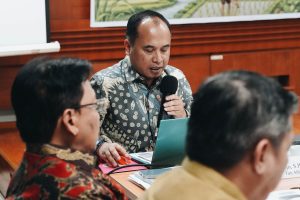
During the discussion session, Prof. Dr. Jangkung Handoyo Mulyo, M.Ec. emphasized that agriculture is a high-risk sector. Therefore, farmer protection should focus on access to land, price certainty, capital, production inputs, crop insurance, and affirmative support for small-scale and new-entry farmers.
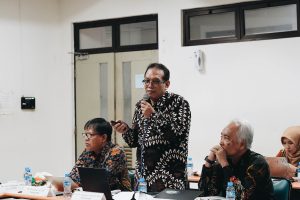
Meanwhile, Prof. Dr. Jamhari, S.P., M.P. encouraged a paradigm shift in agricultural policy from a subsidy-based approach toward an incentive-based approach. He stressed that farmers should not only be seen as food producers, but also as key actors in maintaining soil, water, the environment, and the sustainability of rural areas.
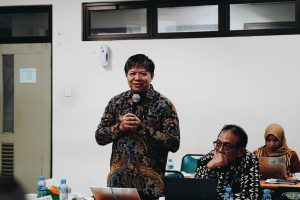
In addition to academics, the forum also involved various stakeholders, including practitioners and representatives of young farmers, who provided input on the draft regulation. All perspectives shared in the seminar are expected to enrich the substance of the bill, making it more implementable, equitable, and responsive to the needs of farmers across regions.
This initiative also supports the achievement of the Sustainable Development Goals (SDGs), particularly SDG 2: Zero hunger, SDG 8: Decent work and economic growth, SDG 15: Life on land, and SDG 16: Peace, justice, and strong institutions. The active participation of faculty members from the Department of Social and Economic Sciences at UGM in this forum exemplifies the academic community’s contribution to supporting the formulation of agricultural policies grounded in scientific research and real-world needs in the field.
Author: Natasya Putri Alifia, S.P.
Admin of the Website for the Department of Agricultural Socio-Economics, Faculty of Agriculture, UGM